71.2°F
Current conditions from King Hill
Updated every 5 minutes
 
  Monday July 13, 2026


NWS Area Forecast Discussion


277
FXUS61 KBTV 131901
AFDBTV

Area Forecast Discussion
National Weather Service Burlington VT
301 PM EDT Mon Jul 13 2026

.WHAT HAS CHANGED...
As of 301 PM EDT Monday...

Have added in enhanced wording to zone forecasts in northern
portions of Vermont and northeastern New York for damaging winds.

&&

.KEY MESSAGES...
As of 301 PM EDT Monday...

1. A Heat Advisory is in effect for most of Vermont and
northern New York on Tuesday. Some localized fire weather concerns
are possible.

2. An enhanced risk of severe thunderstorms remains for
northeastern New York and northern Vermont Tuesday night when
significant severe weather and isolated flash flooding is
possible. A more typical potential for showers and perhaps some
thunderstorms returns for Thursday.

3. Near to slightly below average temperatures and dry
conditions are expected Friday before temperatures moderate back to
around average over the weekend as chances for showers and a few
thunderstorms return.

&&

.DISCUSSION...
As of 301 PM EDT Monday...

KEY MESSAGE 1: Following a stretch of warm days with low humidity,
significantly hotter and more humid air remains on track for
tomorrow. The 925 millibar mean temperatures across guidance
continues to suggest extreme heat building through the day (values
in the range of 26 to 28 Celsius at 5 PM translates to temperatures
in the mid to upper 90s at near ground level in our deeper valleys).
Statistical guidance continues to trend slightly higher for surface
temperatures. The most unusual heat relative to climatology still
looks to develop over the southern Champlain Valley due to westerly
downsloping, but not far off will be the entire Champlain Valley and
St. Lawrence Valley as hot air surges in from the southwest. Looking
at greatest potential for near record high temperatures in this area
with an opportunity to approach 100, while low to mid 90s are common
elsewhere between 2 and 7 PM. The air mass does look humid but not
quite oppressive, which keeps us largely thinking higher end Heat
Advisory and not Extreme Heat Warning level for this event,
especially due to the gustiness and deep mixing we`ll see through
the day given the increasing pressure gradient as temperatures soar.
Note that the Adirondack region which is currently not in the
Advisory is borderline for our criteria with slightly higher heat
and humidity compared to the higher terrain areas in Vermont, and
may need to be added if forecasted temperatures tick up any further.
Depending on later development of convection/rain cooled air,
unusually breezy conditions and humid air will slow the cooling
curve into the evening, supporting uncomfortable heat lingering into
the night, especially in more urban areas.

As sharply drier air returns behind a strong cold front on
Wednesday, low relative humidities in combination with gusty west-
northwest to near 25 MPH will pose a fire weather risk in southern
portions of our region. This area will have had an extended dry
period if they miss out on rain Tuesday night. Think the Upper
Valley and lower elevations in Addison, Rutland and Windsor counties
will be vulnerable to fire starts and spread, so this is something
to keep in mind following the active weather on Tuesday.

KEY MESSAGE 2: A regionally higher end, unusual severe thunderstorm
setup continues to be on target based on the latest forecast data.
Both global synoptic scale and nested, convection allowing models,
with high CAPE and high shear along with a clear trigger with a
strong shortwave energy colocated with a southward moving cold
front. The overlap of CAPE and shear of this magnitude per the ECMWF
Extreme Forecast Index is near the upper end of climatology (very
extreme), especially towards the International Border. While there
is a lot of typical spread in location/timing of the deep convection
based on different initiation and storm motions. The latest full run
of the HRRR shows a reasonable depiction of how things may play out,
with the targeted area primarily from northeastern Vermont and
points east. The NCAR hazard guidance using this model and machine
learning techniques shows a very high probability of severe
thunderstorms, again centered to our east in southern Maine, but
extending westward into northern New York considering the inherent
uncertainty in the location of these types of systems. Risk timing
is greatest between 7 PM and midnight. All hazards are possible,
including low probabilities of wind gusts greater than 70 MPH and a
tornado risk, although we emphasize straight line winds are much
more likely to be the hazard in this environment given fairly
straight hodographs in the low levels. The risk dwindles somewhat as
one goes south and west as dwindling instability with time suggests
a weakening trend with these storms; however, a long tracked, well-
developed line or supercell poses some risk across our region,
consistent with the Slight (level 2) risk of severe thunderstorms
south of the Enhanced area (level 3).

To summarize the convective threat: the pre-storm environment
Tuesday evening will likely have effective shear of near 60
knots, associated with upper level winds near 70 knots and 700
millibar winds near 40 knots, and MUCAPE near 2000 J/kg; local
research shows these parameters are conducive to a combination
of supercells and quasi-linear convective systems, which produce
widespread damaging wind along with localized, brief tornadoes.
The chances for significant impacts (wind damage and/or
isolated flooding) in northeastern Vermont continue to be
favored, with somewhat lower chances towards the south and west.
One failure mode for this event (severe weather does not occur)
is if the initial deep convection misses to our east; in this
scenario, showers ahead of the cold front only come through our
area later in the night when instability has waned. As with all
deep convection, isolated flash flooding will be possible,
especially if thunderstorms redevelop on the western periphery
of linear segments while the mesoscale system shifts southward.
Guidance in the latest forecast cycle has backed off a little
bit on this potential, but bears watching.

Following this activity and any additional showers ahead of the cold
front early Wednesday morning, the next chance for showers and
thunderstorms comes on Thursday ahead of a weaker variety cold
front. This front will also come from the north, but with much less
heat and humidity to work with and more limited wind shear, expect
much less impact with perhaps a couple of afternoon/evening
thunderstorms depending on the timing of convection.

KEY MESSAGE 3: Model consensus is strong for dry conditions Friday with
temperatures in the mid/upper 70s to around 80 degrees as a northern
stream continental airmass tracks over the region. Spread in models
solutions increase over the weekend especially in timing of the next
precipitation features. Blended and ensemble guidance are leaning
towards periods of showers moisture lifting southwest to northeast
Saturday while mid-range deterministic models have a more defined
gap of drier conditions with precipitation shunted south of Vermont
due to a trough digging more sharply southward. The forecast for the
weekend is tracking more closely to blended guidance and persistence
at this time with widespread 30% chances of showers and potentially
some afternoon thunderstorms, but will reserve some judgment and
watch trends closely over the next couple of days given the drier
trend in deterministic runs. Shower chances later Sunday into Monday
continue to line up with another passing trough that is nearly
universally present across model guidances suggesting an increase in
statistical confidence that forecast 30-50% chances of showers
remain valid.

&&

.AVIATION /18Z MONDAY THROUGH SATURDAY/...
Through 18Z Tuesday...Pervasive VFR conditions will continue with the
primary threat to aviators being some LLWS overnight into Tuesday
05-14Z. Weaker flow this afternoon will decrease overnight under
nocturnal stability. As westerly flow aloft increases, some LLWS
will develop and continue through daybreak. Coupling south to
southwest surface winds 12-15Z will remove the threat of LLWS, but
will result in some SFC gusts 20- 25kts in general and up to 30kts at
MSS where flow aligns with the St Lawrence Valley.

Outlook...

Tuesday Night: VFR. Chance SHRA, Slight chance TSRA.
Wednesday: VFR. NO SIG WX.
Wednesday Night: VFR. NO SIG WX.
Thursday: VFR. Slight chance SHRA, Slight chance TSRA.
Thursday Night: VFR. NO SIG WX.
Friday: VFR. NO SIG WX.
Friday Night: VFR. Slight chance SHRA.
Saturday: VFR. Chance SHRA, Slight chance TSRA.

&&

.CLIMATE...
High temperatures on Tuesday will be hot, but we are at the
climatological warmest part of the year. Therefore, it is far from a
certainty that any records will occur.

MSS looks most likely to set a new record. PBG also is
currently forecast to set a new record. MPV, and especially BTV
and SLK, are unlikely to do so. See below for current records:

Max Temp Records
Date     BTV      MPV       MSS      PBG      SLK
07-14  100|1995  94|1952   92|2012  95|1952  95|1934

High Min Temp Records
DatePBG
07-14   70|1974

&&

.BTV WATCHES/WARNINGS/ADVISORIES...
VT...Heat Advisory from 11 AM to 8 PM EDT Tuesday for VTZ001>011-
     016>018-020-021.
NY...Heat Advisory from 11 AM to 8 PM EDT Tuesday for NYZ026>029-
     031-035-087.

&&

$$

WHAT HAS CHANGED...Kutikoff
DISCUSSION...Kutikoff/Boyd
AVIATION...Boyd
CLIMATE...NWS BTV


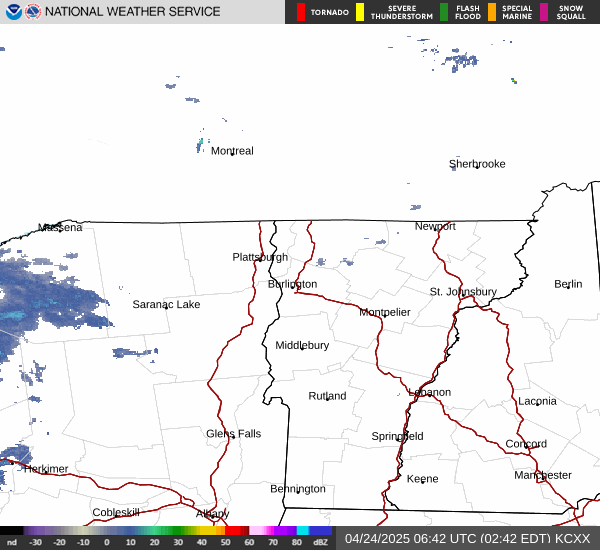
Current Radar Loop:

Sun Position

Copyright © WestfordWeather.net 2007-2026. All rights reserved.